
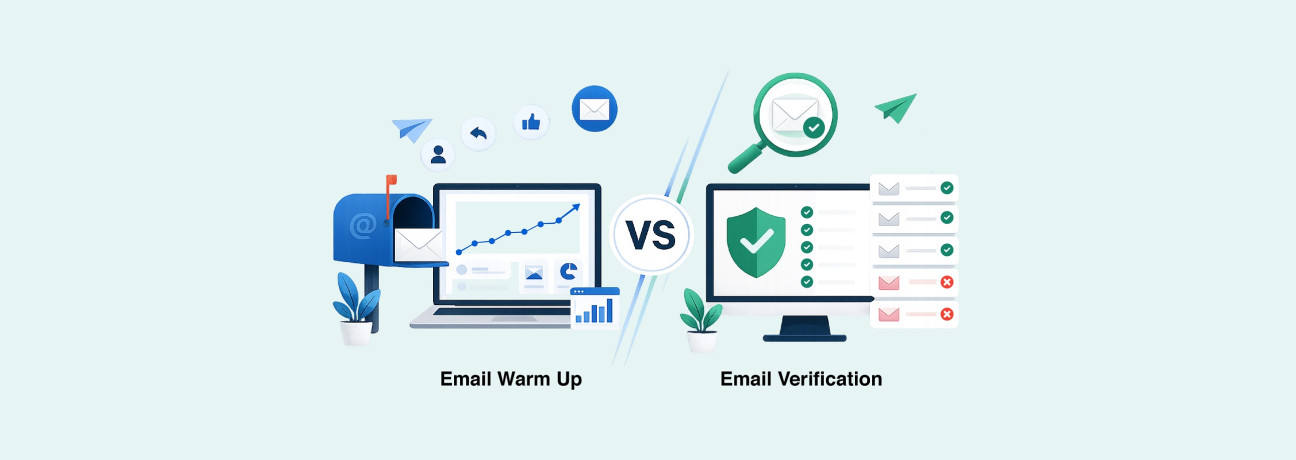
Today, every industry relies on email, where marketers send campaigns, recruiters reach candidates, SaaS companies on-board clients, startups run cold outreach, and sales teams pitch products to clients. The reality is that most of those emails never reach the intended recipient. They bounce back, get flagged into spam, or get blocked by filters, leaving businesses with lost opportunities.
Have you ever wondered why this happens? The reason behind this is often that senders skip two crucial steps: Email Warm-up and Email Verification.
Email Warm-Up builds a sender’s credibility with email service providers, while verification ensures the email addresses in their list are valid and active.
In this blog, we will explore the difference between these two strategies, why both are essential, and how combining them can transform your email success across various industries.
What is Email Warm-Up?
Email warm-up is the process of gradually increasing the email volume from a new or inactive domain or IP address. This strategy aims to improve the sender reputation with various email service providers (ESPs). Rather than sending out thousands of emails all at once, you begin with a smaller volume and slowly scale up. This approach proves to Email Service Providers (ESPs) like Gmail, Outlook, and Yahoo that you are a trustworthy sender.
Email Warm-up is significant in several scenarios:
- Launching a new domain with no prior sending history.
- Startups sending cold outreach campaigns to reach potential customers.
- Businesses scaling up their email volume for marketing campaigns or sales outreach.
- Companies are moving to a dedicated IP that hasn’t been warmed up yet.
Without an effective warm-up, a sudden spike in email activity can feel suspicious and may trigger spam filters or lead to blacklisting. Conversely, a well-executed warm-up strategy builds trust, enhances inbox placement, and safeguards your sender reputation.
What is Email Verification?
Email verification ensures the email addresses you are sending to recipients are valid and active. Using a reliable Email Verification Tool, you can filter out invalid or disposable email addresses from your list. This process helps to reduce bounce rates, protect your reputation, and enhance engagement.
Whether you are sending newsletters, sales campaigns, or product updates. Email List Verification keeps your database clean and accurate. By filtering out invalid addresses, it ensures your emails reach real, engaged recipients, maintaining campaign efficiency and protecting sender reputation.
Key Differences between Email Warm-Up and Email Verification
| Email Warm-Up | Email Verification | |
|---|---|---|
| Purpose | Builds trust with email providers by gradually increasing sending activity | Ensures email addresses are valid, active, and can be sent to recipients |
| When to Use | For new domains or new IPs with low sender reputation | Before every email campaign to keep the email list clean and avoid bounce rate |
| Impact | Improves sender reputation and inbox placement | Reduce bounce rate, avoid spam traps, and prevent blacklisting |
Note: Using both together improves email deliverability and protects both the sender reputation and email list.
Reasons Why You Need Both Email Warm-Up and Email Verification
Emails are effective only if they reach the inbox. Email warm-up and verification help businesses from startups to enterprises improve deliverability, reach real recipients, and protect sender reputation.
For Email Warm-Up:
1. Earn Trust with Email Service Providers (ESPs)
If you send a large number of emails at once from a new or inactive domain/IP, it can trigger spam filters. By gradually ramping up activity, ESPs recognize you as a legitimate sender, increasing inbox placement and ensuring your emails reach recipients reliably. For example, even if you send emails to different domains, like your-company.net and example.com, Google Workspace may count them together toward your daily limit because both domains use Google’s email servers.
2. Build a Positive Sender Reputation
Consistent warm-up patterns help your domain or IP gain a trustworthy sending history. This improves your sender reputation with mailbox providers, which in turn helps more of your emails reach the inbox. A structured email warm-up process strengthens your reputation and supports consistent email deliverability.
3. Maximize Campaign Effectiveness
Warmed-up domains experience higher open rates and better engagement. Businesses running cold email outreach especially benefit, as their emails are more likely to reach the inbox, which improves overall campaign ROI.
For Email Verification:
1. Verify Email List Quality
Email verification checks every email address in your list to identify invalid, disposable, and catch-all email addresses before your campaign is sent. Removing these addresses helps reduce hard bounces, improve deliverability, and ensure your emails reach genuine recipients.
2. Improve Campaign Performance
A high-quality email list leads to more reliable campaign results. By removing undeliverable and high-risk email addresses before sending, email verification helps improve open rates, click-through rates, and conversions, while providing more accurate engagement metrics to measure campaign performance.
3. Protect Sender Reputation
Every hard bounce sends a negative signal to mailbox providers. Regular email verification helps reduce bounce rates by preventing emails from being sent to invalid addresses. Maintaining a clean email list supports consistent inbox placement, protects your sender reputation, and reduces the risk of blacklisting.
Best Practices for Email Warm-Up
Following these best practices can help you warm up your domain safely, build a strong sender reputation, and improve email deliverability.
1. Gradually Increase Your Sending Volume
Avoid sending a large number of emails from a new or inactive domain immediately. Instead, start with a small daily sending volume and increase it gradually over time.
While mailbox providers do not publish a fixed daily limit, many deliverability experts recommend starting with around 10–20 emails per day for a new or inactive domain. As your sender reputation improves, you can gradually increase your sending volume based on engagement and delivery performance. Using an automated email warm-up tool can also help manage sending schedules and monitor your progress throughout the process.
2. Choose the Right Sending Infrastructure
Your sending infrastructure should match your email volume. For most businesses, shared IPs provided by services such as Google Workspace or Microsoft 365 are sufficient and already have an established sending reputation.
If you plan to send high-volume email campaigns, a dedicated IP may be a better option. However, because a dedicated IP starts without an established reputation, it should be warmed up gradually before sending larger email volumes.
3. Create Content That Encourages Engagement
Mailbox providers consider recipient engagement when evaluating sender reputation. During the warm-up process, focus on sending relevant, personalized emails that encourage opens, replies, and clicks.
Positive engagement signals help mailbox providers build trust in your domain, improving inbox placement and supporting better email deliverability.
Best Practices for Email Verification
Email verification is most effective when it becomes a regular part of your email workflow rather than a one-time cleanup task. Following these best practices helps you maintain a healthier email list and improve the quality of every campaign.
1. Verify Your Email List Before Every Campaign
Don't assume an existing email list is still accurate. People change jobs, businesses update their domains, and email addresses become invalid over time. Verifying your email list before each campaign helps identify invalid, disposable, catch-all, and other undeliverable email addresses before they affect your results.
2. Validate Email Addresses at the Point of Collection
The easiest way to maintain a clean email list is to prevent invalid email addresses from entering it. Adding a real-time email validation widget to your signup forms allows email addresses to be validated as users submit them. This helps detect formatting errors, disposable email addresses, and invalid domains before they are added to your database.
3. Review Catch-All Email Addresses Before Sending
Catch-all domains are configured to accept incoming emails even when the existence of the individual mailbox cannot always be confirmed. Since these addresses cannot be fully verified, they may carry a higher delivery risk than standard email addresses. Depending on your campaign goals, consider reviewing and segmenting catch-all email addresses separately before sending.
4. Make Email Verification Part of Your Regular Workflow
Email verification should be part of your regular email workflow rather than something you do only before large campaigns. Whether you're importing new leads, collecting website signups, or preparing a marketing campaign, regularly verifying your email lists helps maintain better data quality and supports consistent email deliverability.
How Warm-Up and Verification Work Together for Email Deliverability
Email warm-up and email verification solve different deliverability challenges, but they work best when used together. Warm-up helps establish trust with mailbox providers by gradually building your sender reputation, while email verification ensures you're sending to valid and deliverable email addresses.
Using only one of these strategies leaves a gap in your email deliverability process. A warmed-up domain can still experience high bounce rates if the email list contains invalid addresses, while a verified email list cannot overcome the reputation challenges of a new or inactive sending domain. Combining both practices helps reduce bounce rates, improve inbox placement, and build a more reliable email sending strategy.
Bottom Line
Successful email campaigns depend on both who you send to and how you send. Email warm-up helps build trust with mailbox providers, while email verification improves the quality of your email list by identifying invalid and risky email addresses before you launch a campaign.
Using these strategies together helps reduce bounce rate, improve inbox placement, and protect your sender reputation. Whether you're running cold outreach, marketing campaigns, or transactional emails, combining email warm-up with regular email verification provides a stronger foundation for consistent email deliverability.