
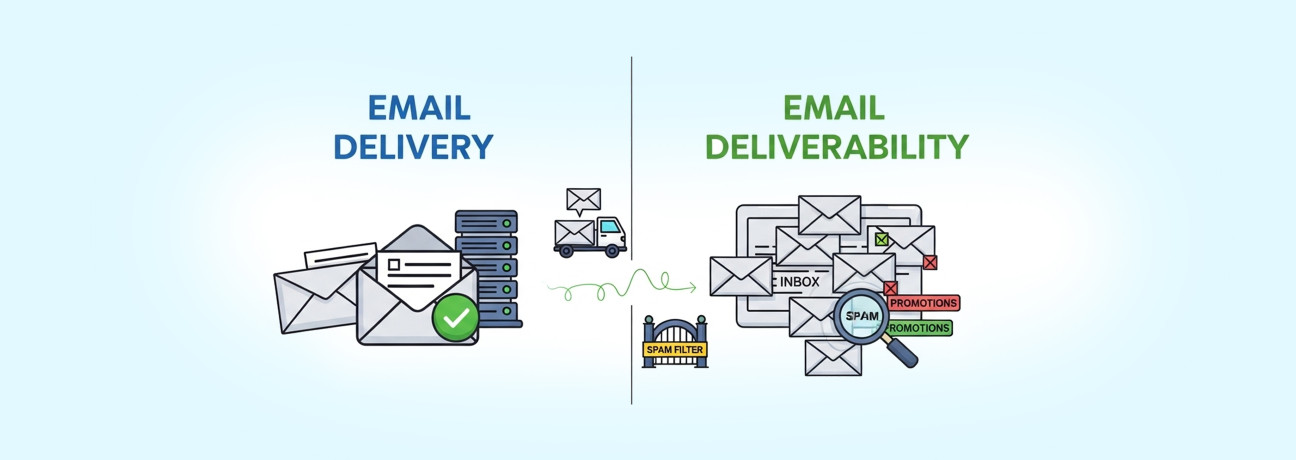
In email marketing, the terms "email delivery" and "email deliverability" are often confused. Even though they sound similar, they aren’t the same. While email delivery tells you whether your email reached a mail server without bounce back, email deliverability tells you whether it reached the recipient’s inbox. But understanding the key difference between them helps you to maintain a good sender reputation.
By the end of this article, you will have gained practical insight into applying those differences to enhance email deliverability performance and achieve better outcomes.
What Is Email Delivery?
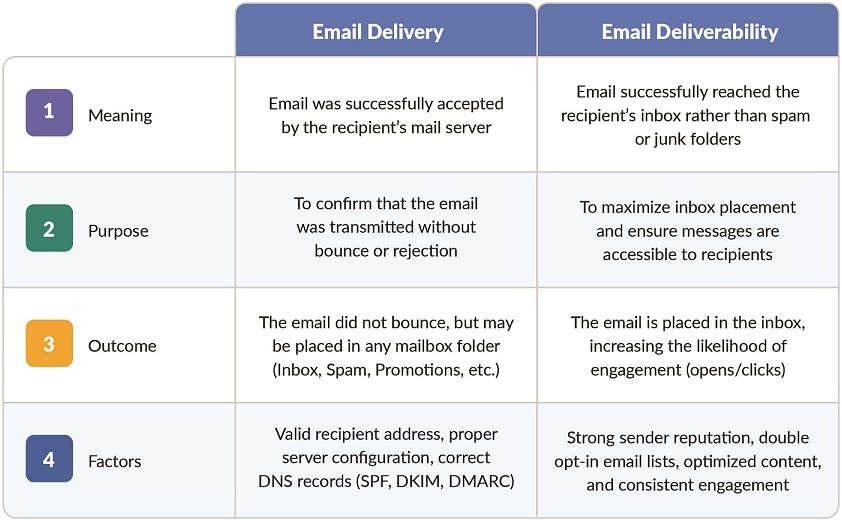
Email delivery confirms whether your email reaches the recipient’s mailbox. In simple terms, this means the email was accepted by the recipient's server (such as Gmail, Yahoo, or Outlook) without being bounced back. However, delivery does not guarantee that the email appears in the recipient’s inbox; it may be routed to other folders, such as spam or junk.
What Affects Email Delivery?
Here are key reasons your emails may not reach the recipient’s server.
⭐
Sending to invalid or mistyped email addresses
⭐
Using a blacklisted domain or IP address
⭐
Misconfigured email settings, such as missing SPF, DKIM, or DMARC records.
⭐
Exceeding sending limits imposed by the recipient or sending server, which can result in temporary delivery failures.
⭐
Soft bounces can also affect delivery when the recipient’s mailbox is full.
Calculation of Email Delivery
Email Delivery Rate Formula:
Email Delivery Rate (%) =
Emails Delivered
Emails Sent
× 100
To understand email delivery, let's look at a simple calculation.
Example:
●
Emails Sent: 100,000
●
Emails Bounced (not delivered): 3,000
●
Emails Delivered: 100,000 − 3,000 = 97,000
Delivery Rate = (97,000 ÷ 100,000) × 100 = 97%
In this example, 97% of emails were successfully delivered to recipient addresses.
What is Email Deliverability?
Email deliverability or inbox deliverability is the ability of emails to reach the recipient’s inbox instead of spam or junk folders. When your email is delivered to the inbox, there are more chances of being opened and read by the recipient.
What Affects Email Deliverability?
Key factors that influence email deliverability include:
1
Sender Reputation: It depends upon bounce rates, spam complaints, open rates, etc.
2
Email List Quality: Email lists with invalid addresses can hurt your sender reputation.
3
Authentication: Lacking SPF, DKIM, or DMARC records can cause ISPs to flag your emails.
4
Content Triggers: Spammy keywords, too many links, or large images can make spam filters flag your emails.
5
Engagement History: Low open or click rates lower your reputation over time.
Calculation of Email Deliverability
Email Deliverability Rate Formula:
Email Deliverability Rate (%) =
Emails to Inbox
Emails Delivered
× 100
To understand email deliverability, let's look at a simple calculation.
Example:
●
Emails Sent: 100,000
●
Bounced Emails: 3,000
●
Emails Delivered: 100,000 − 3,000 = 97,000
●
Emails that landed in the inbox (not spam): 38,800
Delivery Rate = (38,800÷ 97,000) × 100 = 40%
In this example, 40% of your emails reach the inbox and the rest likely end up in spam.
Why Email Marketers Should Care About the Difference
According to Validity’s Email Deliverability Benchmark Report, the average delivery rate across industries is around 98%. The study also shows that only about 80% of delivered emails actually reach the inbox, remaining emails being filtered into spam or junk folders.
For example, if you send 100,000 marketing emails and 98% are delivered (accepted by servers), only about 80% of those delivered emails (78,400 emails) may land in the inbox, depending on your sender reputation and list quality. Maintaining a clean email list is critical here, and using a tool like bulk email verification software helps remove invalid addresses, allowing more of your emails to reach real inboxes and gradually enhancing the email deliverability rate.
Ultimately, this explains why marketers often see low open and click-through rates despite reporting high delivery numbers. The true measure of success isn’t just server acceptance, it’s inbox placement and recipient engagement.
Frequently Asked Questions (FAQs) on Email Deliverability & Delivery
1. What causes good delivery but poor deliverability?
Your emails may be delivered to the server, but they may still be sent to spam if your sender reputation is low, your content appears spam-like, or recipients aren’t opening your emails.
2. How does email verification reduce bounce rates?
Email Verification Software removes invalid addresses before you send, preventing hard and soft bounces.
3. What’s a good sender reputation score?
A good sender reputation is typically 80% or higher , or marked as 'Good' on most email tools, such as Talos, SenderScore, or Google Postmaster.
4. Is a high delivery rate the same as a high deliverability rate?
No, they are not the same.
●
Delivery rate measures the percentage of emails that were successfully accepted by the recipient’s mail server (i.e., they didn’t bounce).
●
Deliverability rate measures how many of the delivered emails actually land in the inbox, rather than being sent to spam or junk.
5. Why are my emails going to the spam folder, even though my delivery rate is high?
A high delivery rate means emails reach the recipient's mailbox. However, they can still end up in the spam folder if your sender's reputation is poor, authentication methods like SPF, DKIM, and DMARC are missing, or engagement is low.
6. Does the email subject line affect email deliverability?
Yes. Spam filters monitor subject lines, and if they appear spammy or misleading, your emails may be prevented from reaching the inbox.