
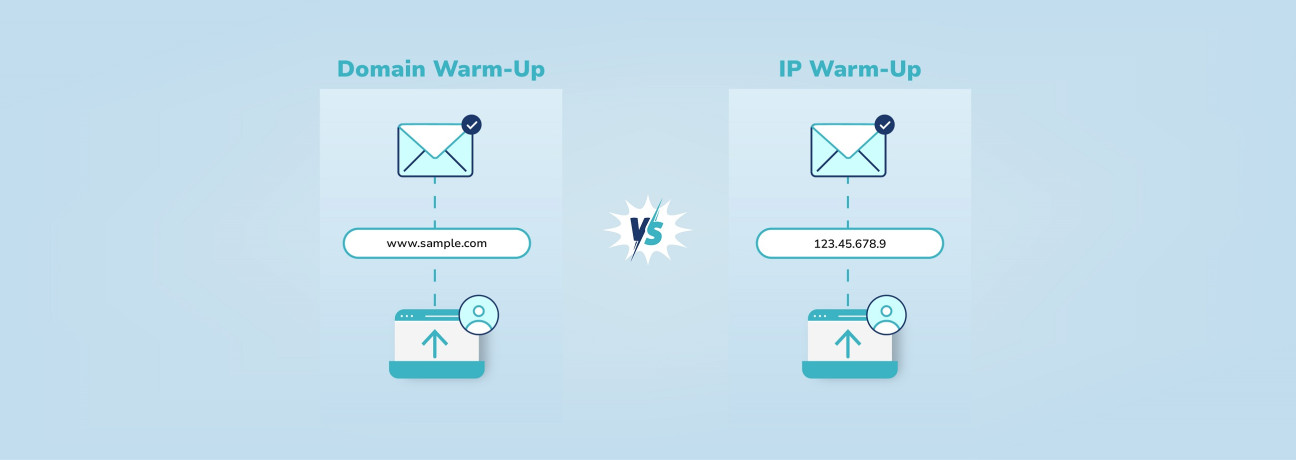
When email deliverability is discussed, IP warm-up often gets most of the attention. Many senders assume that once an IP is warmed up, emails will reach inboxes reliably. While IP warm-up is important, it only covers part of the story.
Mailbox providers also evaluate the reputation of the sending domain. Even when using a trusted or shared IP, a new or unfamiliar domain with no sending history or a domain listed on blacklists by spam-monitoring organizations may still struggle to reach inboxes. Without building trust for the domain, emails may be filtered, throttled, or sent to spam.
Domains aren’t trusted instantly. Mailbox providers watch sending behavior, engagement, and consistency before giving a domain a good reputation. Skipping domain warm-up can lead to deliverability issues that IP warm-up alone cannot fix.
In this blog, we’ll explain what email warm-up means, the difference between IP and domain warm-up, how mailbox providers evaluate domain reputation, and why domain warm-up is crucial for long-term inbox success.
What Is Email Warm-Up?
Email warm-up is the process of building trust with mailbox providers by gradually increasing your daily email volume while sending consistently and responsibly.
Mailbox providers like Gmail, Outlook, and Yahoo monitor new senders closely. Sudden spikes in email volume can look suspicious and may trigger spam filters.
Email warm-up helps mailbox providers see that:
✔️
Your sending patterns are predictable
✔️
Recipients engage with your emails
✔️
Spam complaints and bounce rates stay low
What Is IP Warm-Up?
IP warm-up is the process of gradually increasing the volume of emails sent from a new or inactive IP address.
It is needed when:
✔️
Using a new dedicated IP
✔️
Switching from shared to dedicated sending
✔️
Starting sending again after a long break
✔️
Your IP Reputation Was Previously Damaged
Gradually increasing email volume helps mailbox providers see that your sending patterns are consistent and trustworthy. IP warm-up builds trust for the IP address, but it does not establish domain reputation, which is why domain warm-up is also required.
What Is Domain Warm-Up?
Your domain is your sending identity, the name recipients see when they receive your emails. Mailbox providers use it to determine whether your emails are trustworthy.
Domain warm-up is the process of gradually building trust in your domain by consistently and responsibly sending emails over time.
How Domain Warm-Up Works
Domain warm-up focuses on:
●
Building a positive sending history
●
Sending emails consistently without sudden spikes
●
Getting engagement from recipients
●
Avoiding spam complaints and sending to invalid addresses
A domain stays tied to your business long-term, and its reputation travels across different IPs and email services. Mailbox providers treat domain behavior as a key factor in determining email reliability.
Why Domain Reputation Matters
Mailbox providers watch:
●
Frequency of emails sent from your domain
●
Recipient engagement with your emails
●
Spam reports
●
Bounce and complaint rates
A domain reputation builds slowly but lasts longer than IP reputation. A strong domain reputation is essential for keeping your emails in inboxes consistently over time.
Why Compare Domain Warm-Up and IP Warm-Up?
Many senders think:
“If I warm up my IP, my emails will automatically reach inboxes.”
This is not true. Mailbox providers evaluate both IP and domain together. If either looks risky, your emails may still land in spam.
Common mistakes:
●
Warming up an IP but using a brand-new domain
●
Switching IPs to avoid a poor domain reputation
●
Using shared IPs while ignoring domain health
IP trust alone cannot ensure inbox placement, which is why domain warm-up is equally important.
Domain Warm-Up vs IP Warm-Up: Key Differences
Mailbox providers evaluate IPs and domains differently. Understanding these differences helps improve email delivery and long-term sender reputation.
| IP Warm-Up | Domain Warm-Up |
|---|---|
| Focuses on how emails are sent | Focuses on who is sending the emails |
| Evaluates the sending server or infrastructure | Evaluates the sender’s identity and brand |
| Helps emails get accepted by mailbox servers | Builds your domain reputation with mailbox providers |
| Reputation tied to the IP address | Reputation tied to your domain name |
| Can be reset by changing IPs or ESPs | Persists even if IPs or ESPs change |
| Supports short-term delivery stability | Important for long-term sender trust |
| Plays a supporting role in inbox placement | Plays a key role in overall email deliverability |
Who Should Focus on Domain Warm-Up?
If you’re sending emails from a new domain or trying new sending patterns, mailbox providers don’t know your domain yet.
Domain warm-up is especially helpful for:
●
Startups and new businesses using a new domain
●
SaaS companies sending onboarding emails
●
Cold outreach teams reaching prospects for the first time
●
Marketers scaling campaigns quickly
●
Businesses recovering from spam or deliverability issues
Even experienced senders may need domain warm-up when:
●
Launching campaigns from a new domain
●
Reactivating a previously inactive domain
●
Changing sending patterns, audience size, or email frequency
Taking the time to warm up your domain helps mailbox providers recognize your emails as trustworthy. Over time, this improves inbox placement and ensures your messages reach recipients reliably.
How Mailbox Providers Evaluate Domain Reputation
Mailbox providers evaluate your domain by monitoring its behavior over time and tracking how recipients engage with your emails.
Sending Volume Changes
Mailbox providers track how many emails your domain sends each day. Gradual, steady growth looks normal, while sudden jumps may raise concerns.
Recipient Engagement
Opens, clicks, and replies show that your emails are relevant. Low engagement slows the building of domain trust.
Spam Complaints
Even a few users marking your emails as spam can negatively impact your domain reputation.
Bounce and Delivery Quality
Sending to invalid or disposable email addresses indicates poor list hygiene and can hurt credibility.
Consistency Over Time
Regular, predictable sending helps build a positive reputation. Sending in large bursts or with long gaps slows domain trust growth.
For long-term inbox success, know the difference between
Email Deliverability and Email Delivery.
Email Deliverability and Email Delivery.
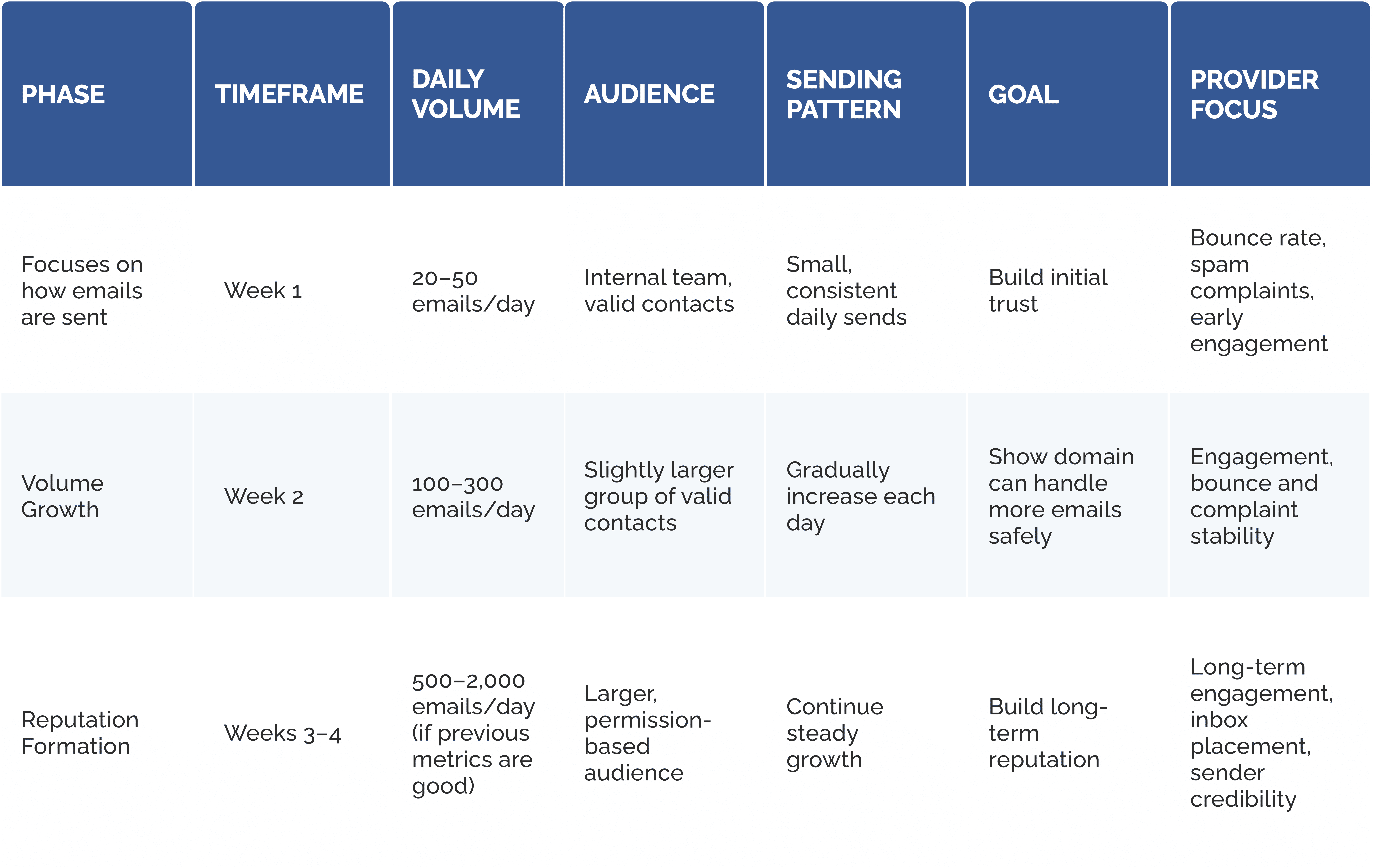
Practical Sending Volumes for a New Domain
When sending emails from a new domain, mailbox providers expect gradual growth rather than sudden large volumes. Slowly increasing your email sending helps your domain build trust and improve deliverability. Here’s a safe way to warm up your domain in phases:
Bottom Line
Email warm-up is about building trust, not hitting a daily sending limit. Mailbox providers look at both the technical setup (IP) and the sending domain.
IP warm-up shows that your infrastructure is safe, but domain warm-up shapes how mailbox providers judge your domain over time.
If your domain has a weak reputation, IP warm-up alone won’t guarantee inbox placement. Sending consistently, engaging with real contacts, and maintaining clean lists helps mailbox providers trust your domain.
When IP and domain warm-up are done together, your emails are more likely to reach inboxes reliably, even as sending volumes grow or infrastructure changes.
Frequently Asked Questions (FAQs) on Domain and IP Warm-Up
1. Do I need IP warm-up if I’m using a shared IP (like Mailchimp or HubSpot)?
No, shared IPs are usually pre-warmed, so you don’t need to warm them yourself. Focus on maintaining good sending practices.
2. Is domain warm-up required even if the IP is already trusted?
Yes. Mailbox providers check domain reputation separately, so warming the domain is still important for deliverability.
3. Which is more important: Domain Warm-Up or IP Warm-Up?
Both matters. IP warm-up builds trust for the sending IP address, while domain warm-up builds trust for your sender identity. Skipping either can hurt inbox placement.
4. How long does domain warm-up usually take?
Typically 2–8 weeks, depending on email volume, engagement, and sending consistency.
5. Can poor list quality affect both domain and IP warm-up?
Yes. Invalid emails or low engagement can trigger bounces and spam complaints, damaging both IP and domain reputation.
6. Is engagement more important for domain warm-up or IP warm-up?
Engagement matters for both, but it has a bigger impact on domain reputation since mailbox providers track how recipients interact with your emails.
7. Does domain warm-up apply to subdomains?
Yes. Subdomains are treated separately, so they need their own warm-up if used for sending.
8. My domain is old, but this is my first email campaign. Will mailbox providers trust it automatically?
No. Even an old domain is treated as new if it has no sending history. Starting slowly and warming it up builds trust.