

As companies plan their 2026 marketing budgets, one question stands out: Are we maximizing ROI from email marketing, or just seeing inconsistent metrics?
Despite being a reliable and cost-effective email marketing channel across industries, results often feel unpredictable. Open rates fluctuate, workflows underperform, and campaign outcomes vary even with a consistent strategy.
The issue isn't content, tools, or strategy. It’s about data quality, specifically the accuracy of your email list.
As email data quality declines, undeliverable addresses and outdated contacts can erode campaign effectiveness. Without understanding how to measure and optimize list accuracy, your email ROI will remain elusive.
In practical terms, email ROI becomes far more predictable when list accuracy stays close to 99%, a level where bounce rates remain low and performance metrics reflect real audience behavior rather than data loss.
In this blog, we’ll explore how email list accuracy impacts ROI and why investing in a 99% accurate list is key to predictable returns in 2026.
Understanding Email Marketing ROI
Email marketing ROI shows how much profit a business makes from its email campaigns compared to how much it spends on them. It helps marketers evaluate whether their email efforts are generating profitable outcomes.
Understanding ROI in marketing is crucial for evaluating how effectively your email campaigns contribute to overall business growth and revenue.
ROI is calculated by comparing the revenue from email campaigns with the total costs involved, including marketing tools, email list acquisition, campaign setup, and ongoing maintenance. The standard formula is:
Email Marketing ROI (%) = [
Revenue – Marketing Cost
Emails Sent
] × 100
For example, if an email campaign generates $10,000 in revenue while incurring $2,000 in total marketing costs, the resulting ROI is 400%. This means that for every $1 invested in email marketing, the business generates $4 in revenue.
Statistics: Email Marketing ROI by Industry
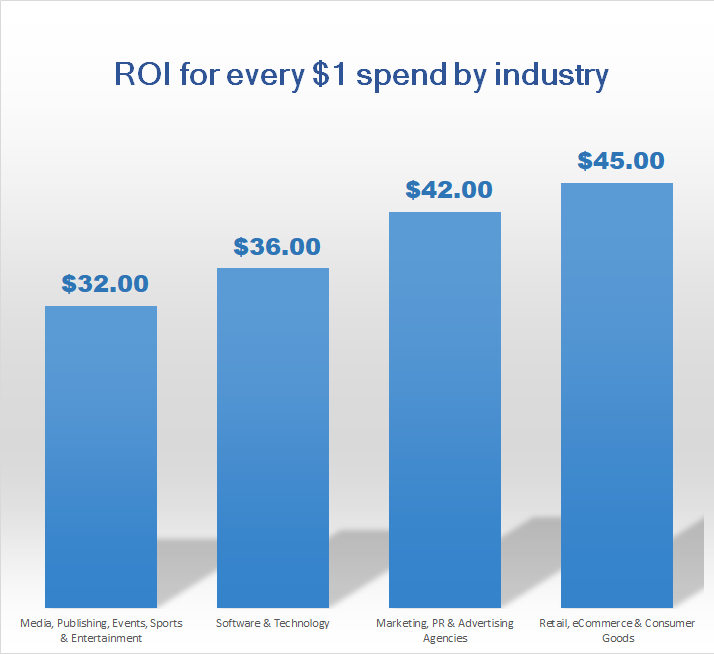
Email marketing continues to deliver exceptional returns across industries, with ROI strongly influenced by the accuracy and quality of email lists. While revenue is the ultimate measure of ROI, Litmus industry benchmarks provide insight into how effectively email drives business outcomes.
Media, Publishing, Events, Sports & Entertainment
Organizations in media, publishing, events, sports, and entertainment rely heavily on email to maintain ongoing connections with their audiences. Emails are used to share content, announce events, provide updates, and promote tickets or subscriptions. By delivering timely, relevant, and engaging content, these organizations are able to turn every $1 spent on email marketing into $32 of revenue, demonstrating the channel’s ability to monetize audience attention effectively.
Software & Technology
Software and technology companies use email as a critical tool to onboard new users, educate customers on product features, and encourage renewals or upgrades. Consistent, targeted email campaigns keep users engaged over longer buying cycles, nurture leads, and support upselling initiatives. With these strategies, every $1 invested in email marketing generates $36 in revenue, highlighting the value of email in driving long-term revenue and customer retention.
Marketing, PR & Advertising Agencies
Agencies rely on email to maintain strong client relationships and generate new business opportunities. Campaigns often include industry insights, case studies, or personalized recommendations that demonstrate expertise and value. By sending relevant messages to engaged contacts, agencies can convert email communication into measurable revenue, achieving $42 in return for every $1 spent on email campaigns.
Retail, eCommerce & Consumer Goods
Retail and eCommerce brands use email to influence purchasing behavior directly through promotions, product recommendations, and abandoned cart reminders. Email provides a measurable connection between marketing efforts and sales, and with effective targeting and accurate lists, these organizations generate $45 in revenue for every $1 invested, making email one of the most impactful channels in driving transactions.
Factors That Reduce Email Marketing ROI
Even high-performing email programs can see ROI decline if email list quality isn’t actively maintained. Common factors include natural list decay, rising bounce rates, poor inbox placement, wasted operational spend, and unreliable performance metrics.
Natural Email List Decay: Email contacts frequently change jobs, dormant mailboxes, or use temporary/disposable email addresses. As a result, B2B email lists can lose around 22.5% of contacts each year. If these outdated contacts aren’t removed or updated, fewer emails reach real recipients, lowering campaign effectiveness and limiting potential revenue.
Rising Bounce Rates: Invalid and outdated addresses increase bounce rates, which can signal poor list hygiene to mailbox providers. This may affect deliverability even to legitimate contacts, limiting the impact of future campaigns.
For a clearer understanding, check out What Is Email Bounce and How Many Types Are There? to learn how different bounces affect deliverability.
Declining Inbox Placement: Invalid or unengaged email lists can trigger filtering into spam or promotions folders, lowering visibility and engagement among active subscribers.
Wasted Operational Spend: Sending emails to unreachable addresses consumes budget on tools, automation, and team effort without producing results, eroding ROI over time.
Unreliable Performance Metrics: Sending emails to outdated or invalid contact lists can distort campaign data, making metrics such as engagement, conversions, and revenue tracking less accurate. This often leads teams to invest additional budget into optimization efforts without addressing the root cause.
Case Study: Studies show that regularly cleaning and segmenting email lists can have a significant impact on campaign performance and ROI. By removing invalid, outdated, or inactive contacts and grouping subscribers by engagement or interests, marketers can ensure emails reach the right audience. Analysis found that applying these practices led to a 46% increase in open rates and a 500% increase in click-through rates, demonstrating how proper list management not only improves visibility but also drives meaningful engagement and revenue.
Top Strategies for Consistent Email ROI
Consistent email ROI is achieved through repeatable processes that safeguard performance as lists grow and change. The key isn’t sending more campaigns, but maintaining control over the data behind every email send.
Keep Email Lists Clean
Regularly updating your email list with Bulk Email Validator Software to remove invalid, outdated, or inactive contacts helps reduce bounce rates, improve inbox placement rate, and ensure your budget is spent only on contacts that can engage or convert.
Prevent Invalid Emails at Signup
Verifying email addresses during signup or lead capture with an
email validation widget helps catch typos, disposable emails, and invalid domains before they enter the email list. Preventing poor-quality data at the point of collection reduces future cleanup efforts and protects deliverability from the start.
email validation widget helps catch typos, disposable emails, and invalid domains before they enter the email list. Preventing poor-quality data at the point of collection reduces future cleanup efforts and protects deliverability from the start.
Protect Inbox Placement
Inbox placement plays a direct role in ROI. Monitoring bounce rates, spam complaints, and engagement trends enables early identification of deliverability issues. When emails consistently reach the inbox, campaign performance reflects message quality rather than filtering or blocking.
Send Emails to the Right People
Sending every campaign to an entire list often reduces engagement and skews performance metrics. Focusing on active and relevant contacts based on recent engagement, behavior, and intent improves response rates and provides a more accurate view of campaign effectiveness.
Use Accurate Data for Tracking and Planning
Reliable email data makes it easier to track performance, understand what drives results, and plan future campaigns with confidence. When metrics reflect real engagement, they allow you to allocate budgets more effectively, prioritize high-impact initiatives, and maintain predictable ROI over time.
Bottom Line
Email marketing can continue to deliver a strong ROI in 2026, but only when performance is predictable. Inaccurate email lists introduce hidden costs, reduce deliverability, and distort performance metrics, making ROI appear inconsistent even when the strategy remains unchanged.
By investing in high email list accuracy, organizations reduce wasted spend, improve inbox placement, and gain more reliable performance data. This enables marketing leaders to plan budgets with confidence and treat email as a stable, revenue-generating channel rather than a variable expense.
For companies focused on efficiency and accountability, accurate email data is not optional. It is essential for achieving a consistent, measurable email ROI in 2026.