
Email marketing delivers exceptional ROI, but only if one critical asset is in place: the quality and health of your email database.
Across CRMs, marketing platforms, and sales systems, contact data continuously degrades as users change roles, abandon inboxes, switch domains, or submit invalid information during signup. This silent degradation is known as email list decay.
In the following sections, we break down what email list decay is, why it occurs, how it impacts deliverability and engagement, and the strategies businesses can implement to maintain a healthy and accurate email database.
What Is Email List Decay?
Email list decay is the gradual deterioration of an email database over time as contact records become outdated, inactive, or invalid. As database accuracy declines, email lists become less reliable for marketing, sales, and customer communication.
Industry research suggests that email marketing databases can decay by approximately 22.5% annually, meaning nearly 1 in 4 email records may become outdated, inactive, or invalid each year.
Email list decay can affect deliverability, engagement rates, campaign performance, and sender reputation.
Common Causes of Email List Decay
The following are some of the most common factors that contribute to email list decay.
Changes in Business Email Addresses
In B2B environments, changes in employment are a primary reason for email list decay. When professionals change jobs or move to a new organization, their previous business email addresses are often deactivated. This creates outdated records within CRM systems, marketing databases, and sales pipelines.
Company Changes and Domain Migrations
Business events such as mergers, acquisitions, rebranding initiatives, or domain migrations can affect email address validity. During these transitions, organizations may retire legacy email addresses, modify email routing, or discontinue older domains, causing previously valid contacts to become unreachable.
Use of Disposable Email Addresses
Some users sign up for downloads, webinars, free trials, or gated content using temporary email addresses. Because these addresses are designed for short-term use, they often expire soon after registration, reducing the long-term value of acquired contacts.
Abandoned or Inactive Email Accounts
Subscribers may stop using older email accounts as they switch to new providers, change their preferred inbox, or lose access to existing accounts. While these addresses may continue to accept messages, engagement often declines as the accounts become inactive.
Data Entry and Data Collection Errors
Some invalid records enter the database from the start due to data-entry errors during form submissions. Typographical errors, incorrect domain names, missing characters, and formatting issues can result in undeliverable email addresses, increasing bounce rates, and reducing overall database quality.
Subscriber Disengagement
Not all email list decay is caused by invalid email addresses. Some subscribers remain reachable but gradually stop opening, clicking, or interacting with email campaigns. As engagement declines, these contacts contribute less value and can make campaign performance more difficult to measure accurately.
High-Risk Email Address Types
Certain address types are more likely to affect list quality. Role-based email accounts, such as sales@, info@, or support@, are often shared by multiple users and may generate lower engagement. Similarly, catch-all domains can make it difficult to determine whether a specific mailbox is valid and actively monitored.
The Hidden Impact of Email List Decay on Deliverability and Engagement
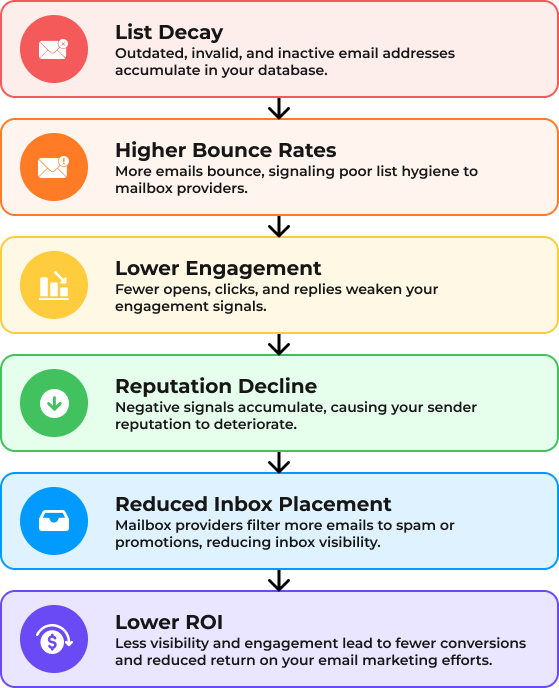
Email list decay influences the performance signals mailbox providers use to evaluate sender quality, affecting deliverability, engagement, and overall campaign effectiveness.
1. Increased Bounce Rates
As email databases deteriorate, a larger share of campaign volume is directed toward contacts that can no longer receive messages. This results in higher bounce rates and signals that list maintenance practices may be inadequate.
Consistently high bounce rates can weaken a sender's reputation and reduce the confidence mailbox providers place in a sender. Understanding the different types of email bounces can help businesses identify underlying list quality issues and take corrective action more effectively.
2. Reduced Inbox Placement
Mailbox providers assess multiple factors when determining whether emails should be delivered to the inbox, promotions tab, or spam folder. These factors include sender reputation, engagement performance, authentication practices, and list quality.
When email list decay goes unmanaged, declining engagement and recurring delivery failures can weaken these signals. As a result, organizations may experience:
- Reduced inbox placement
- Increased spam folder placement
- Lower visibility among engaged subscribers
Even when emails are successfully delivered, they may not consistently reach the primary inbox.
3. Less Reliable Engagement Metrics
A declining email database can make campaign reporting less accurate and more difficult to interpret. As audience quality decreases, engagement metrics may no longer reflect the behavior of active subscribers.
This can lead to:
- Lower open and click rates
- Distorted campaign performance metrics
- Reduced visibility into subscriber interests
- Less reliable optimization decisions
As a result, marketing teams may struggle to accurately evaluate performance and identify opportunities for improvement.
4. Increased Sender Reputation Risk
Sender reputation plays a critical role in long-term email deliverability. Mailbox providers continuously monitor sending behavior to assess whether messages should be trusted.
Email list decay can contribute to several negative reputation signals, including:
- Elevated bounce rates
- Declining engagement levels
- Increased spam complaints
- Continued outreach to abandoned or high-risk addresses
As these signals accumulate, maintaining consistent inbox placement becomes more challenging, increasing the risk of deliverability issues across future campaigns.
5. Lower Marketing Efficiency and ROI
As email list decay progresses, a growing portion of marketing resources may be spent on contacts that are unlikely to engage with email campaigns or contribute to conversion goals.
This can result in:
- Lower conversion efficiency
- Reduced campaign ROI
- Less effective audience targeting
- Increased marketing and operational costs
How to Control Email List Decay?
Organizations can reduce email list decay through a combination of regular email verification, subscriber validation practices, and ongoing engagement monitoring.
1. Maintain Email Database Quality
Maintaining email list quality requires ongoing attention. Regular bulk email verification helps identify deliverability risks before they affect campaign performance. Verifying email lists before major campaigns or at scheduled intervals can help maintain database accuracy and support long-term list hygiene.
2. Implement Double Opt-In
Double opt-in requires new subscribers to confirm their email address before being added to a mailing list. This additional verification step helps prevent fake registrations, data-entry errors, and low-quality signups from entering the database.
3. Monitor Subscriber Engagement
Not all email list decay is caused by invalid email addresses. Some subscribers remain reachable but gradually stop engaging with email campaigns.
Monitoring engagement metrics such as opens, clicks, and conversions can help identify inactive segments and provide a clearer view of overall audience quality.
4. Run Re-Engagement and Sunset Campaigns
Before removing inactive subscribers, businesses can run targeted re-engagement campaigns to determine whether contacts still wish to receive communications.
Subscribers who remain unresponsive after re-engagement efforts can be removed from future campaigns, helping maintain a more engaged and accurate email database.
Bottom Line
Email list decay is a continuous process that can gradually affect email deliverability, engagement, sender reputation, and marketing ROI.
Controlling email list decay requires a combination of regular email verification, subscriber validation practices, engagement monitoring, and consistent email list hygiene. Together, these efforts help organizations maintain healthier databases and support stronger long-term email marketing performance.
Ultimately, successful email marketing depends not on the size of a database but on the ability to consistently reach engaged, reachable contacts with accurate, high-quality data.