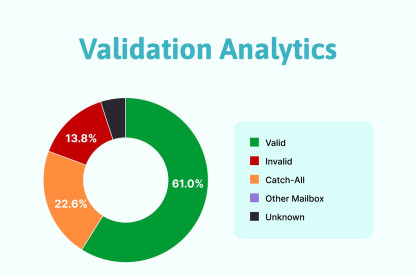
Your Customer Relationship Management (CRM) system is only as valuable as the data it contains. But as businesses collect leads from signup forms, marketing campaigns, sales outreach, and customer interactions, maintaining accurate email records becomes increasingly challenging.
Invalid, fake, outdated, and disposable email addresses can quietly affect campaign performance, reduce sales productivity, increase bounce rates, and damage sender reputation. Even minor data quality issues can create larger problems across marketing automation, customer communication, and sales workflows.
While manual data cleaning helps maintain CRM health, it does not stop invalid data from entering the database. That’s why many businesses are turning to automated email verification API to validate email addresses in real time and maintain healthier CRM data at scale.
In this guide, we'll explore why businesses integrate automated Email Verification APIs to improve data quality, deliverability, and overall CRM performance.
What is an Email Verification API?
An email verification API is a service that validates email addresses through API requests by performing checks such as syntax validation, domain and MX record lookup, and SMTP mailbox verification.
The system processes each request in real time or in bulk and returns a structured response (typically JSON) indicating whether the email is valid, invalid, or risky.
Businesses use it to ensure only valid email addresses enter their CRM or marketing systems, helping reduce bounce rates and improve email deliverability and campaign performance.
How Bad Email Data Gets Into Your CRM
Bad email data rarely enters a CRM system through a single source. Instead, it accumulates gradually through everyday sales and marketing activities, making it difficult to identify until data quality begins to decline.
Signup Forms and Lead Capture Pages
Website forms are the most common entry points for bad email addresses. Some users enter invalid or temporary email addresses to access gated content, free trials, or promotional offers, while typographical errors during form submission can also result in inaccurate email records.
Bulk Imports and Third-Party Contact Lists
Sales and marketing teams often import contact lists into their CRM systems to support outreach campaigns and lead generation efforts. However, imported databases may contain invalid email addresses, introducing data quality issues even before campaigns begin.
Manual Data Entry
Even small typing errors during manual entry can result in inaccurate CRM records. A missing character or an incorrect domain may seem minor, but such errors often go unnoticed and continue to affect sales and marketing workflows.
Outdated Customer Records
Even email addresses that were valid when they entered your CRM can become outdated as customer information changes. People change jobs, companies switch domains, and inactive inboxes are eventually abandoned. According to HubSpot, business contact data can decay by 22% to 30% each year, making ongoing data maintenance an important part of CRM management.
As customer databases grow, even regularly updated CRM records can become inaccurate without a process for ongoing validation and maintenance.
The Real Cost of Invalid Email Addresses
Invalid email addresses can increase costs, reduce efficiency, and impact the effectiveness of email marketing campaigns. The following are some of the most common ways they affect business performance.
Increased Marketing Costs: Many CRM and email marketing platforms base their pricing on the number of contacts stored or the emails sent. As a result, invalid email addresses can increase marketing costs by occupying database space and consuming resources without contributing to campaign performance.
Reduced Sales Productivity: Accurate contact data is essential for effective sales outreach. When email addresses are invalid, sales teams may spend additional time verifying contacts, handling bounced emails, and recovering lost opportunities, reducing overall productivity.
Deliverability and Sender Reputation Risks: Repeated emails sent to invalid addresses can increase bounce rates and signal poor list quality to mailbox providers. This can affect sender reputation and limit inbox placement.
Google recommends maintaining good list hygiene and monitoring recipient feedback. According to Google's Email Sender Guidelines, senders should keep their reported spam rate below 0.1% and avoid reaching 0.3%, as higher complaint rates can negatively impact email delivery.
Inaccurate Reporting and Decision-Making: Invalid contacts can distort campaign metrics and reduce the accuracy of performance analysis. Open rates, click-through rates, and conversion data may no longer reflect true audience engagement, leading to decisions based on incomplete insights.
Benefits of Integrating an Email Verification API With Your CRM
Integrating an Email Verification API into your CRM helps ensure that the customer data driving your sales and marketing efforts is accurate from the start. Why does that matter? Because every email address in your database influences campaign performance, customer communication, and reporting accuracy. When invalid, disposable, or risky email addresses are filtered out of your CRM, your teams can focus on engaging real contacts instead of managing data quality issues.
The benefits extend far beyond reducing bounce rates. Verified email addresses help keep your database cleaner, make customer records more reliable, and support more accurate reporting. They also reduce the time spent correcting data issues and make it easier to maintain data quality as your CRM grows. In short, integrating email verification creates a stronger foundation for customer engagement and helps ensure your CRM remains a trusted source of business information.
What to Look for in an Email Verification API
When evaluating an Email Verification API, consider the following capabilities:
- Comprehensive verification that helps identify invalid, inactive, and undeliverable email addresses in the CRM.
- Fast response times that support real-time verification without disrupting form submissions or automated workflows.
- Catch-all domain detection to identify domains where mailbox existence cannot be verified with certainty.
- Real-time and bulk verification capabilities to support both new data collection and ongoing database maintenance.
- Flexible integration options for connecting verification workflows with CRMs, marketing platforms, and custom applications.
- Transparent pricing models that align costs with usage and scale as verification volumes grow.
- Strong privacy and compliance standards that support regulatory requirements such as GDPR and CCPA.
Bottom Line
As customer databases expand, maintaining accurate email information becomes an ongoing operational challenge rather than a one-time cleanup project. The question is no longer whether invalid email addresses exist within a CRM, but how efficiently an organization can identify and manage them before they affect business activities.
An automated Email Verification API provides a scalable way to incorporate email validation into everyday CRM processes. Rather than relying solely on periodic database reviews, businesses can establish a more proactive approach to managing email data as it is collected and updated.
Ultimately, the most effective CRM strategies are built on processes that support data quality. Integrating email verification can help organizations create those processes, enabling teams to work with greater confidence in the customer information they use every day.