
Email deliverability is no longer just about whether your message reaches the inbox. It’s now about whether your email actually gets seen.
For years, mailbox providers focused on filtering spam based on technical factors like sender reputation, authentication, and complaint rates. If your email passed those checks, it had a good chance of landing in the inbox and getting noticed.
But that’s changing fast.
In 2026, inboxes are becoming smarter. Major mailbox providers like Gmail, Yahoo, and Outlook use AI to read, understand, and organize emails before users even open them. Instead of simply delivering messages, these systems decide which emails are important, which ones should be highlighted, and which ones can be pushed aside.
This means two things for email marketers. First, getting into the inbox is no longer enough. Second, content quality and relevance now play a much bigger role in whether your email gets attention.
In this blog, we analyze the impact of AI-powered inboxes on email deliverability, discuss their significance for your email strategy, and provide guidance on maintaining visibility in modern inboxes.
How Inbox Filtering Works Before AI
Before AI, inbox filtering relied mainly on technical checks and how users interacted with emails.
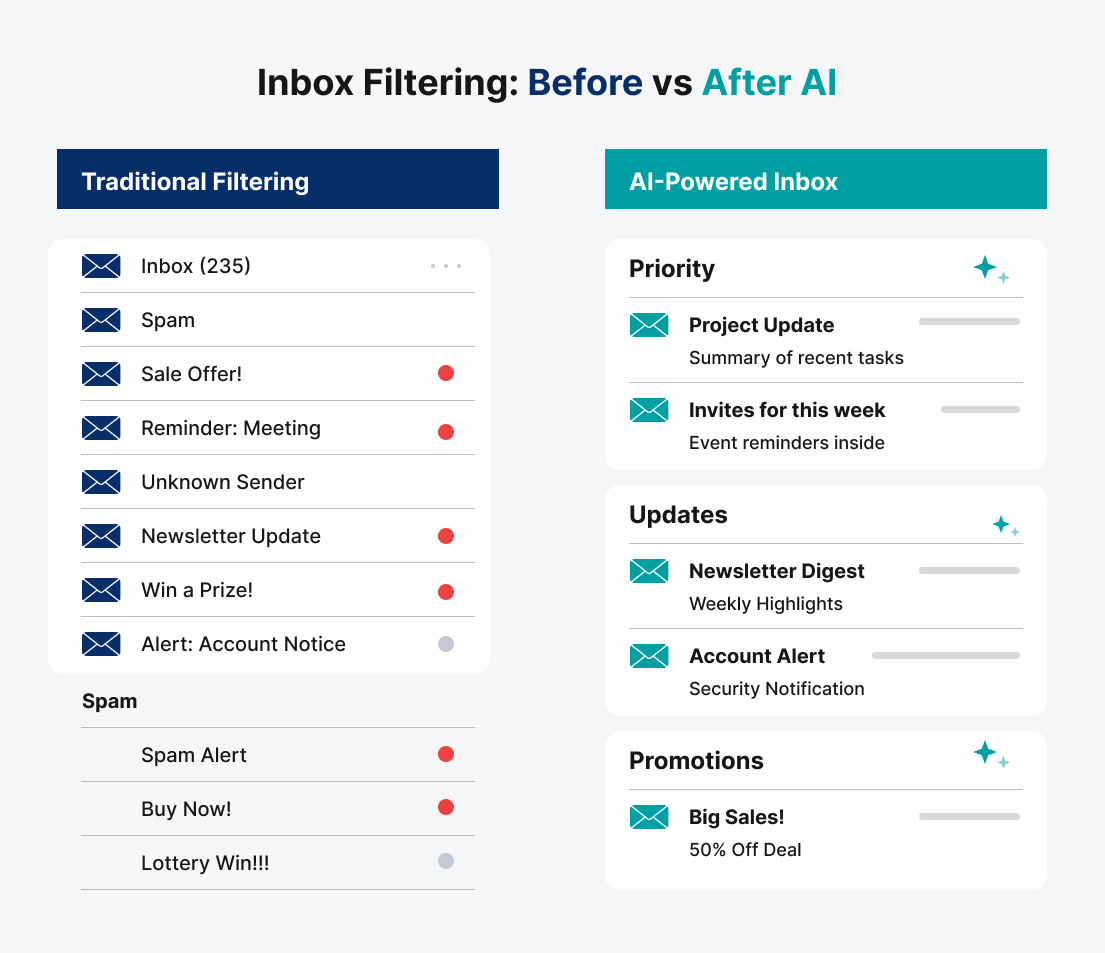
In the early stages, mailbox providers checked emails for spam keywords, suspicious links, and unusual sending patterns. Emails that looked risky were either blocked or sent to the spam folder.
Later, sender reputation became a key factor. Mailbox providers evaluated domain history, authentication (SPF, DKIM, DMARC), spam complaints, and sending consistency. Emails from trusted senders had a higher chance of reaching the inbox.
User engagement also played a role. Mailbox providers looked at how recipients interacted with emails, including opens, clicks, replies, and deletions. Emails with better engagement stayed visible in the inbox more consistently.
In this setup, inbox placement depended mainly on technical checks and sender trust.
However, this method had a limitation. It did not consider what the email actually said or whether the content was useful to the reader.
This gap led to the shift toward AI-driven inbox systems.
How AI Is Reshaping the Inbox
AI is increasingly used by major mailbox providers to manage how emails are displayed and engaged with.
Google has introduced Gemini AI in Gmail, which can summarize long email threads, highlight key information, and help users understand messages without opening them fully. By reviewing complete conversations, AI highlights the most important updates, decisions, and action items, helping users quickly grasp key information.
Microsoft integrates AI into Outlook through Copilot and Focused Inbox, which summarize long threads, prioritize important emails, and highlight relevant details, helping users manage their inbox more efficiently.
Yahoo Mail now uses AI-generated message summaries and a priority inbox to highlight important information and help users scan their inbox more easily, showing key details and suggested actions at a glance.
These AI systems go beyond filtering spam. They analyze the content, purpose, and user interactions for each email to determine how it should be presented. Emails from senders users interact with frequently are prioritized, while less relevant emails receive less attention.
Even when an email is delivered successfully, its visibility and engagement depend on how AI evaluates its relevance and usefulness, making AI a critical factor in inbox performance today.
How AI Is Changing Email Deliverability
AI is changing email deliverability by shifting the focus from delivery status to ongoing user engagement.
Earlier, deliverability was defined by whether an email passed technical checks and reached the inbox. Now, mailbox providers continue evaluating emails even after delivery.
AI systems analyze how recipients interact with emails over multiple sends. Actions such as reading, ignoring, deleting, or engaging with emails influence how future messages from the same sender are treated.
AI keeps learning from these interactions and adjusts how future emails are shown. If emails consistently receive low engagement, their visibility may gradually decrease. In some cases, they may be filtered more strictly despite having a valid technical setup.
At the same time, emails that receive regular engagement continue to stay visible in the inbox.
Another key shift is how emails are presented within the inbox. AI-powered inbox systems are designed to help users focus on high-priority messages. Instead of displaying emails in a simple chronological order, these systems organize messages based on importance, highlight items that require attention, and may summarize key information to improve readability.
This means that even after reaching the inbox, not all emails receive equal visibility. Messages that are clear, relevant, and action-oriented are more likely to be highlighted, while others may be pushed lower in priority.
Content evaluation is also evolving. AI systems assess whether the message is clear, relevant, and aligned with user expectations. Emails that clearly show their purpose and benefit at a glance tend to perform better.
Because of this, deliverability is no longer a one-time outcome. It is an ongoing process influenced by both technical factors and how recipients respond to your emails.
How Email Senders Should Adapt to AI-Driven Inboxes
To perform well in AI-driven inboxes, email strategies need to focus on clarity, relevance, and user interaction.
1. Make Your Message Clear from the Start
AI often displays subject lines, preview text, and the opening lines of an email before a user decides to read it. If the key message is not clear in these elements, users may overlook the email.
What to do:
- Clearly communicate the main message or offer in the subject line and preview text
- Keep opening lines simple, direct, and relevant
- Avoid long or unclear introductions before getting to the point
2. Structure Emails for Easy Reading
Both AI systems and users prefer content that is easy to scan and understand. Well-structured emails are more likely to be understood quickly and engaged with.
What to do:
- Use short paragraphs and simple sentences
- Break content into clear sections
- Use bullet points where appropriate
- Keep the layout clean and organized
3. Focus on Value, Not Just Clicks
Users may understand the purpose of an email from previews or summaries without opening it fully. As a result, clicks are no longer the only measure of success.
What to do:
- Ensure the email communicates value clearly, even in previews
- Focus on meaningful offers, updates, or useful information
- Measure performance using replies, conversions, and overall engagement
4. Maintain a Strong Technical Setup
Technical factors remain essential for ensuring consistent inbox placement. AI builds on these signals rather than replacing them.
What to do:
- Configure authentication correctly (SPF, DKIM, DMARC)
- Maintain consistent sending patterns
- Avoid sudden increases in email volume
5. Send Relevant and Targeted Emails
AI systems provide greater visibility into emails that match a user's interests and past behavior. Relevance plays a key role in maintaining visibility.
What to do:
- Segment your audience based on behavior or preferences
- Send content that aligns with user needs
- Avoid sending the same message to all recipients
6. Keep Your Email List Clean
User engagement directly influences how AI evaluates and displays your emails. Low engagement can reduce visibility over time, while invalid email addresses can negatively impact deliverability and overall list quality.
What to do:
- Regularly remove inactive subscribers who have not engaged over time
- Remove invalid or temporary email addresses using an email validation tool
- Provide a clear and easy unsubscribe option to reduce spam complaints
- Use double opt-in to ensure new subscribers are valid and genuinely interested
- Periodically review and clean your email list to maintain accuracy and engagement
To better understand how to identify valid email addresses, read our guide on How Do You Know if an Email Is Valid.
The Future of Email Deliverability in AI Inboxes
Email deliverability will continue to evolve as AI becomes more advanced and deeply integrated into inbox experiences.
1. More Personalized Inboxes
AI will adapt to individual user behavior and preferences. As a result, each recipient may see a slightly different version of their inbox. This means your emails need to align closely with individual user interests to remain visible.
2. Smarter Content Understanding
AI systems will continue to improve their ability to interpret the intent, tone, and relevance of emails. Generic or low-value messages are less likely to perform well, while clear, well-structured, and useful content will stand out.
3. A Wider Gap Between High- and Low-Quality Emails
The gap between relevant, high-quality emails and low-value messages will continue to grow. Senders who focus on clarity, relevance, and user engagement will perform better, while others may struggle to maintain visibility.
4. Continuous and Dynamic Deliverability
Deliverability will no longer be a one-time outcome. AI will continuously adjust how emails are displayed based on user interaction, engagement patterns, and content performance. This makes it essential to maintain consistency and relevance across every email you send.
Bottom Line
AI-powered inboxes are redefining what email deliverability means.
Reaching the inbox is no longer enough. Emails must be visible, relevant, and engaging to perform effectively.
Marketers need to combine a strong technical foundation with clear, valuable, and easy-to-understand content.
Success in AI-driven inboxes depends on understanding how users view and interact with emails, and aligning your messaging with those expectations.
Frequently Asked Questions on AI and Email Deliverability
1. Are SPF, DKIM, and DMARC enough for AI-driven inbox placement?
SPF, DKIM, and DMARC are no longer enough for inbox placement in 2026. While they are essential for authenticating your emails and avoiding immediate rejection, they only act as a baseline. Modern AI-driven inbox systems also evaluate engagement signals like opens, clicks, and user interactions. If your emails don’t perform well with recipients, their visibility can still decline over time.
2. Will AI-generated email content be flagged as spam by modern filters?
Not necessarily. AI-generated content is not automatically flagged as spam by modern filters. What matters more is the quality, clarity, and relevance of the message. If the content feels generic or doesn’t match user expectations, it may lead to low engagement, which can impact deliverability. Well-structured and valuable content, whether AI-assisted or not, can perform effectively.
3. Can AI help improve my deliverability, or is it just a hurdle?
AI can actually help improve deliverability when used correctly. It can assist in optimizing subject lines, personalizing content, and sending emails at the right time. At the same time, mailbox providers use AI to filter and prioritize emails based on engagement. When used strategically, AI becomes an advantage rather than a challenge.
4. Do AI filters analyze email content and tone?
Yes. AI filters go beyond technical checks and also evaluate the content and tone of emails. They analyze whether the message is clear, relevant, and aligned with what the recipient expects. Emails that are easy to understand and provide clear value are more likely to perform well, while unclear or misleading messages may be deprioritized.
5. How does predictive filtering impact bulk email campaigns?
Predictive filtering uses past recipient behavior to determine how future emails are handled. In bulk campaigns, if a large number of users ignore or delete emails, future messages from the same sender may be filtered more aggressively. This makes targeting the right audience and sending relevant content essential for maintaining inbox visibility.